
Blooming
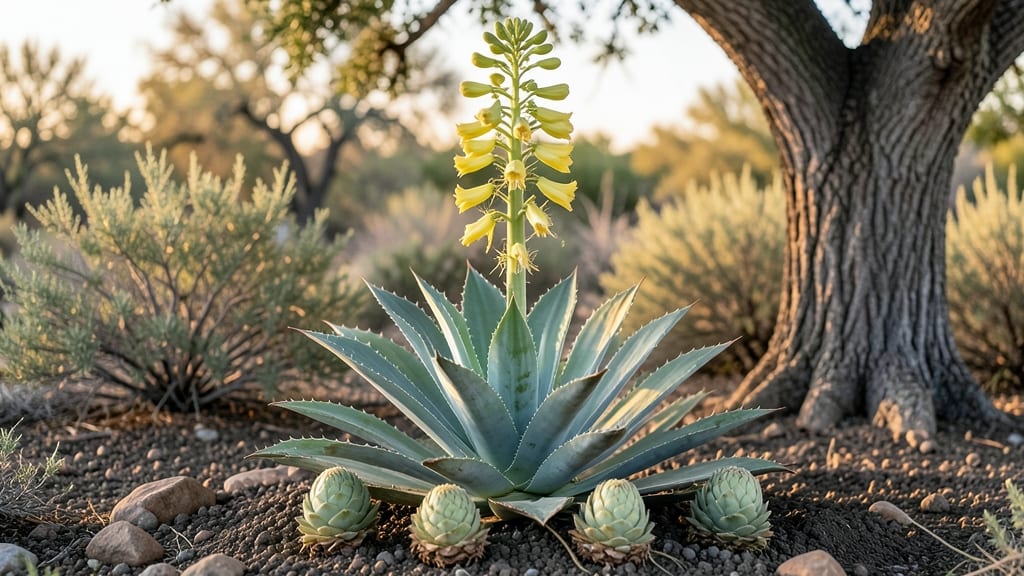
Your agave’s dramatic death bloom is actually its most exciting moment—🌱 and the pups it produces are free plants for your garden. I’ve watched my own agaves go through this cycle, and while the mother plant dies after blooming, those pups at its base are the real goldmine.
The key is knowing which cold-hardy varieties will survive your winters and come back stronger each year.
Most agaves bloom once in their lifetime, then die—but not before sending up 5-20 pups from the base. These offsets are genetically identical to the parent, so you’re essentially cloning your favorite plants.
The timing matters: harvest pups in early spring when they’re about 1/3 the size of the mother plant, before they get too big to transplant easily.
Replanting them is where many gardeners trip up. Use well-draining soil and a pot or ground spot with 6+ hours of sun—they’ll thrive in zones 5-10 if given the right care.
My hardiest varieties, like Agave parryi and Agave americana, have survived -10°F winters with just a little mulch protection.
Here’s the secret: don’t rush to separate pups until they’ve developed their own roots. Wait until you see a 2-inch root system, then gently tease them apart. That first winter is critical—they’ll need extra mulch to make it through.
Trust me, watching those pups grow into mature agaves over the years is worth the patience.
📚 In This Guide
- What you need
- Instructions
- Tips and common mistakes
- Wrapping up and next steps
What you need
- ● Cold-hardy agave varieties: Choose from Agave americana, Agave parryi, or Agave utahensis (all survive temps down to 10–15°F). Pro tip: 💡 Buy from reputable nurseries or propagate from trusted sources!
- ● Pups (offsets): 3–5 healthy pups per plant (harvest when they’re 1/3 the size of the mother plant and have their own roots).
- ● Well-draining soil: Cactus/succulent mix (or 50% potting soil + 50% perlite/pumice). Avoid garden soil—it’s too dense!
- ● Containers or garden bed: For containers: 6–12" pots with drainage holes (1 pup per pot).
- ● For in-ground planting: Full sun spot with 6+ hours of light daily and sandy, rocky soil.
- ○ Rooting hormone (optional but helpful): Cloning gel or powder to boost pup survival rates.
- ● Watering can with a narrow spout: For precise hydration (agave hates soggy roots!).
- ● Mulch: Gravel or crushed rock to protect roots in winter (critical for frost-prone zones).
- ● Slow-release fertilizer: Low-nitrogen (e.g., 5-10-10) for established plants in spring.
- ● Thermometer: To monitor soil temps—agave thrives in 70–90°F but can handle brief cold snaps.
- ● Garden gloves: For handling spiky leaves (trust us, they’re not cuddly!).
How to grow cold-hardy agave pups after the death bloom
Here's how I've learned to keep agave pups thriving even after their dramatic death bloom—no green thumb required.
🌱 Step 1: Identify and Separate Healthy Pups
Once your agave sends up its spectacular death bloom, focus on the pups that form at its base. Look for ones with at least 3-4 leaves that are deep green and firm to touch. Avoid any pups that appear yellowed, mushy, or smaller than a softball—these won't survive transplanting.
I wait until the mother plant's bloom fully dies back and the pups are 4-6 inches tall before digging. This ensures they've built enough energy reserves. Use a sharp knife to cut through the roots connecting the pup to the parent, leaving at least 1 inch of root attached to each pup. This prevents shock and encourages new root growth.
☀️ Step 2: Prepare the New Planting Site
Cold-hardy agave varieties like 'Blue Glow', 'Parry's Agave', or 'Filifera' need full sun exposure (6+ hours daily) and well-draining soil. I always amend the planting area with 1 part coarse sand or grit per 3 parts native soil to prevent rot—agave roots despise soggy conditions.
Choose a spot with shelter from strong winds, especially in your climate's frost zone. If you're in USDA zones 5-7, plant pups in late spring after the last frost date. The soil should be 60-70°F—warmer than that, and the roots may dry out too quickly.
🪴 Step 3: Transplant Pups with Care
Dig a hole twice as wide as the pup's root ball but only as deep as the root system. The top of the pup should sit at or slightly above soil level—burying the crown invites rot. Gently place the pup in the hole and backfill with native soil, tamping lightly to remove air pockets.
Water deeply right after planting to settle the soil, but don't drown it. You'll know it's right when water drains through the bottom of the hole within 10-15 minutes. Mulch with 1-2 inches of gravel or bark chips (never organic mulch—it holds too much moisture). This mimics their desert origins and keeps roots cool in summer.
⏰ Step 4: Establish a Watering Routine
For the first 2-3 weeks, water pups every 5-7 days until the soil feels dry 2 inches down. After that, cut back to every 2-3 weeks—overwatering is the #1 killer of agave. You'll see healthy growth when new leaves emerge with a slight blue-green tint and the plant stands upright.
In winter, reduce watering to once a month or when the soil feels completely dry. Cold-hardy varieties like 'Parry's Agave' can handle 10°F dips, but their roots need to dry out between waterings. If leaves start curling or turning yellow, that's your signal to hold off on watering.
✂️ Step 5: Protect During Frost and Encourage Regrowth
When nighttime temps drop below 25°F, cover pups with burlap or frost cloth secured loosely at the base. Remove it during the day to prevent overheating. I've seen 'Blue Glow' agave survive down to 15°F with this protection—just don't let it sit wet.
In early spring, fertilize lightly with a balanced 10-10-10 fertilizer diluted to half strength. You'll know it's working when you see 2-3 new leaves per pup within 4-6 weeks. Avoid heavy-handed feeding—agave grows slow and steady, not fast and flashy.
Tips & tricks for thriving cold-hardy agave pups
These tried-and-true strategies will help your agave pups grow strong and resilient after that showstopping death bloom.
Pup Selection Precision: In Step 1, when choosing pups with 3-4 leaves, pay extra attention to the leaf bases. Healthy pups will have tight, firm bases without any soft spots or brown edges. I've lost count of how many pups I've discarded that looked fine above ground but had hidden rot at the base. This step alone makes the difference between thriving plants and sad losses.
Soil Mix Matters: The 1:3 sand-to-soil ratio in Step 2 is non-negotiable for cold-hardy varieties. I've seen agave pups drown in regular garden soil even in cold climates. For extra insurance, add a handful of perlite to the mix—it helps break up clay soils and prevents compaction. Think of it as giving your agave roots a breath of fresh desert air.
Transplanting Technique: When creating that twice-as-wide hole in Step 3, don't just dig deeper—focus on the width. The extra space encourages root expansion without crowding. After planting, I like to give the soil one final firm press with my hands to eliminate air pockets. This helps the roots establish contact with the soil immediately, which is especially important in cooler climates where roots grow slower.
Watering Wisdom: That 10-15 minute drainage test in Step 3 is your golden rule. If water pools on top after 15 minutes, your hole isn't deep enough. For cold-hardy varieties, I recommend adding a 2-inch layer of small gravel at the bottom of the hole before planting. This creates a natural drainage layer that mimics their native rocky soil environments and prevents root rot even in colder, wetter climates.
Pro Tips for Agave Death Bloom Pups
- These tried-and-true strategies will help your agave pups grow strong and resilient after that showstopping death bloom.
- Pup Selection Precision: In Step 1, when choosing pups with 3-4 leaves, pay extra attention to the leaf bases.
- Soil Mix Matters: The 1:3 sand-to-soil ratio in Step 2 is non-negotiable for cold-hardy varieties.
Frequently asked questions
about agave death blooms and their cold-hardy pups—here’s what you need to know before diving in!Can agave plants really survive frost after blooming?
Yes! Many agave varieties, like Agave parryi or Agave utahensis, are cold-hardy and can survive light frosts (15–20°F) even after blooming. However, extreme cold (below 10°F) may still damage or kill the parent plant—but the pups often thrive and regrow. Always mulch heavily in winter for extra protection!
How long does it take for agave pups to mature after the death bloom?
Pups typically appear 2–6 months after the parent agave blooms and dies. Growth speed depends on climate, sunlight, and care. In ideal conditions (full sun, well-draining soil), pups can reach transplant size (6–12 inches) in 1–2 years. Patience is key—rushing can stress young plants!
What’s the best way to propagate agave pups from a dead parent?
Once pups are 4–6 inches tall, carefully dig them up with a clean knife, ensuring each has roots. Let the cuts heal for 1–3 days in shade, then plant in well-draining soil. Water lightly until established (2–4 weeks). Avoid transplanting in extreme heat or cold for best survival rates.
Are there agave varieties that bloom and survive harsh winters?
Look for Agave americana (hardy to 10°F), Agave victoriae-reginae (tolerates 15°F), or Agave schottii (drought-resistant and cold-tolerant). These varieties often rebloom or produce hardy pups even in colder zones. Check your USDA zone for the best matches!
Why did my agave bloom but now has no pups—did I do something wrong?
Not necessarily! Some agaves (like Agave tequilana) produce few or no pups, especially if stressed by overwatering, poor soil, or lack of sunlight. Others may take longer to pup. If your plant is otherwise healthy, wait—pups might still emerge! If not, consider propagating from offsets of neighboring plants.
Pro Tip:
Label your pups as they emerge—some agaves produce dozens in a single bloom! Tracking varieties helps you plan for future landscapes or sales. Plus, it’s a great way to experiment with cold-hardy hybrids.
Wrapping up and next steps
Watching your agave undergo its dramatic death bloom is a breathtaking experience—especially when you know those pups will thrive in your garden! Cold-hardy varieties like Agave parryi or Agave americana prove that resilience and beauty go hand in hand. 🌱❄️
Now that you’re armed with the right knowledge, why not expand your collection? Start by planting a few more pups or sharing the magic with fellow plant lovers. Every bloom is a reminder that even in nature’s toughest moments, life finds a way to grow back stronger.