
Blooming
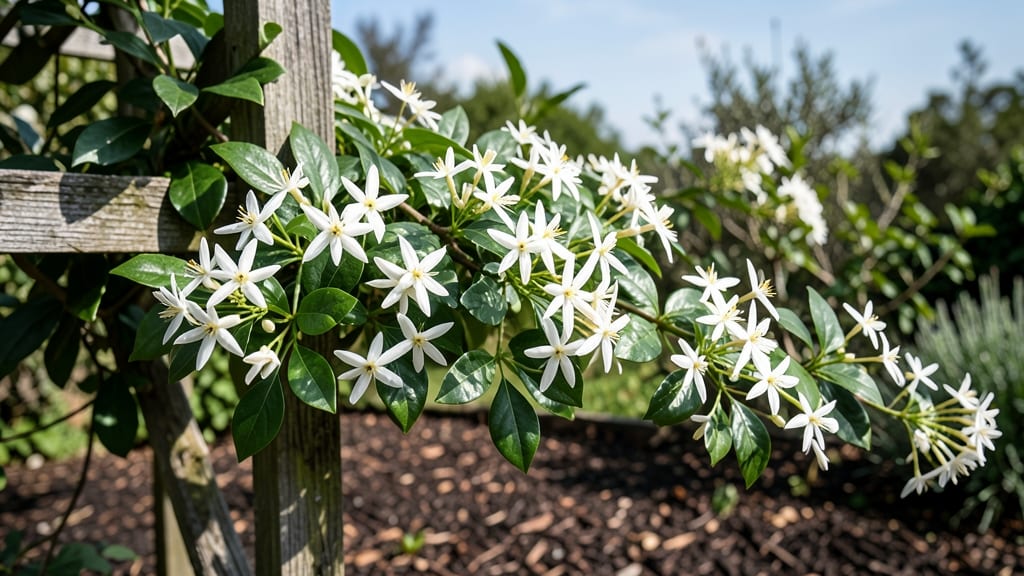
Star jasmine blooms all summer and often continues into fall with proper care, producing fragrant white flowers in waves throughout the growing season. Pruning and consistent moisture encourage prolonged flowering.
Star jasmine's ability to bloom all summer comes from its natural growth patterns—it thrives in warm climates and responds beautifully to consistent care. 🌸 Unlike annuals that bloom once and fade, this evergreen vine produces flowers in cycles, with new buds forming as old ones open.
I've seen it continue flowering well into October in my zone 9 garden, especially after a light pruning in early summer to encourage fresh growth. The key is mimicking its native tropical environment with regular watering and partial shade during peak heat.
What sets star jasmine apart is its resilience—it handles heat better than many climbers and rewards gardeners who provide balanced fertilizer during the growing season. Many people assume it's a one-time bloomer, but with the right conditions, you'll get those signature jasmine-scented flowers appearing in successive waves.
The fragrance alone makes the effort worth it, especially when planted near patios or windows.
💡 In This Article
- Star Jasmine’s Natural Blooming Cycle Explained
- Tips to Extend Star Jasmine’s Summer Blooms
Star jasmine’s natural blooming cycle explained
Star jasmine (Trachelospermum jasminoides) thrives on a unique flowering mechanism that triggers continuous bloom cycles throughout warm seasons.
Unlike single-bloom plants, its flowers develop along new growth stems, creating what botanists call "sympodial branching"—each flower cluster forms at the end of a shoot, while side buds remain dormant until the main bloom fades.
This process repeats every 4-6 weeks under ideal conditions, producing those signature star-shaped white blossoms in successive waves.
The plant’s native habitat in subtropical China explains its heat tolerance—it evolved to bloom prolifically during 75-85°F temperatures with high humidity. When daytime temps stay above 60°F consistently, star jasmine enters "continuous flowering mode," unlike honeysuckle (which blooms in distinct seasonal flushes) or clematis (which often needs winter dormancy).
The fragrance—often described as a sweeter, more floral version of true jasmine—peaks in late morning when temperatures rise, releasing 100+ volatile compounds that create that intoxicating scent.
Light exposure plays a surprising role: while it tolerates partial shade, full sun actually reduces flowering intensity by increasing stress. The plant responds by channeling energy into leaf growth rather than blooms.
In my zone 9b garden, I’ve noticed the most consistent blooms occur with morning sun and afternoon shade, which keeps temperatures moderate while maintaining photosynthesis. This balance explains why star jasmine often out-performs other climbers in hot climates.
What most gardeners miss is the plant’s response to day length. Unlike photoperiod-sensitive plants (like poinsettias), star jasmine doesn’t need short days to bloom—it’s primarily temperature-driven. This makes it uniquely adaptable: in coastal areas with mild winters, it can bloom nearly year-round, while inland regions see spring-to-fall flowering.
The key difference from clematis is that star jasmine doesn’t require a winter rest period to trigger new blooms.
For visual comparison, imagine star jasmine’s blooming pattern as a conveyor belt: each new stem produces flowers that open over 3-5 days, while the next set of buds is already forming behind them.
This contrasts with honeysuckle’s "all-or-nothing" approach, where entire clusters bloom simultaneously before dropping. The result? Star jasmine’s 3-4 month continuous display in optimal conditions—far exceeding most climbers’ 6-8 week peak seasons.
Here’s what’s actually happening at the cellular level: The plant’s meristem cells (growth points) remain active year-round in warm climates, continuously producing floral primordia (flower buds).
When you see those white star-shaped blooms, you’re witnessing the culmination of 4-6 weeks of bud development along each new stem. 🌸 The secret to extending this process lies in maintaining these growth points through proper care.