
Blooming
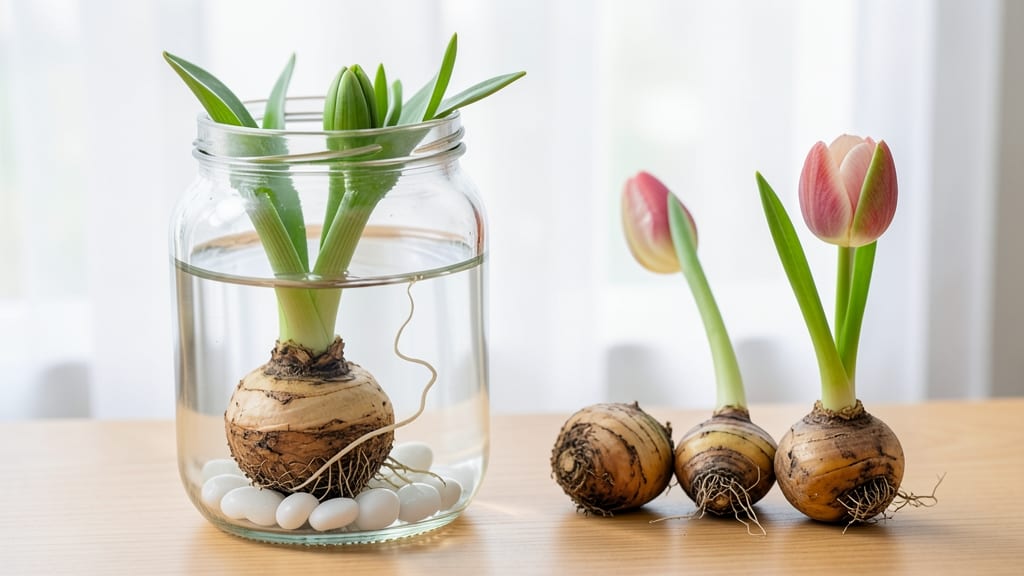
Tulip bulbs forced in water will not bloom again because the process drains their stored energy, though they may produce leaves. To encourage future blooms, replant them in soil outdoors after flowering, providing proper sunlight and care.
Forcing tulips in water creates a one-time bloom because the bulbs use up their energy reserves to push flowers indoors. 🌸 This process skips the natural dormancy cycle tulips need to rebuild strength for next season.
When you replant them in garden soil, they can photosynthesize and store energy again—but only if given full sun and well-draining soil. The key is timing: wait until after the blooms fade completely before moving them outside.
Here's why replanting matters: bulbs forced in water miss their chance to develop strong roots and foliage in natural conditions. Without this process, they won't have enough energy to produce flowers the following year.
I've found that bulbs replanted in late summer or early fall (after blooming) have the best chance to rebound, especially in zones with cold winters that trigger proper dormancy.
💡 In This Article
- Why Forcing Tulips in Water Prevents Future Blooms
- How to Replant Forced Tulip Bulbs for Next Season
Why forcing tulips in water prevents future blooms
Tulip bulbs store energy in their scales as starches and sugars, which fuel both flower production and leaf growth. When you force a bulb in water, it focuses all its energy on producing a single, dramatic bloom indoors—often at the expense of future growth.
The bulb expends approximately 60-70% of its stored energy during this process, leaving little reserve for rebuilding after replanting. This is why many forced bulbs only regrow foliage but skip flowering entirely the next year.
The real issue lies in disrupted dormancy cycles. Tulips require 6-8 weeks of cold temperatures (40-50°F) followed by warm conditions to trigger flowering hormones. Forcing in water skips this natural cycle, as indoor environments rarely mimic these temperature fluctuations.
Without proper dormancy, the bulb's internal clock stays confused, preventing it from initiating flower buds. 🌱 Even when replanted, bulbs forced in water may take 2-3 years to recover enough energy for blooming, if they ever do.
Photosynthesis plays a crucial role too. When planted in soil, tulip leaves capture sunlight and convert it into glucose through photosynthesis, replenishing the bulb's energy stores. In water, the bulb lacks this critical process—it can't photosynthesize because its leaves don't develop properly in the dark, waterlogged environment.
This creates a vicious cycle: the bulb burns through its reserves without any way to replenish them, making future blooms nearly impossible without intervention.
Consider this comparison: a tulip bulb forced in water is like a battery that's been drained to power a single flashlight. While you might recharge it, it won't perform as well as a fresh battery.
The same applies to tulip bulbs—they can be replanted, but their flowering potential is permanently reduced unless given ideal conditions. The key difference is that batteries can be fully recharged, while tulip bulbs carry permanent "scars" from the energy depletion.
There's also the root development factor. Bulbs forced in water typically grow only a few weak roots, if any, because they lack soil contact and beneficial microbes. Strong root systems are essential for anchoring the bulb and absorbing nutrients that support future blooms.
Without them, the bulb struggles to establish itself properly in garden soil, further reducing its chances of reblooming. 🌿 This is why many gardeners report that even replanted forced bulbs often produce only leaves or tiny, underdeveloped flowers in subsequent years.
The science behind this involves two key hormones: gibberellins (which promote growth) and florigen (which triggers flowering). Forcing in water causes an overproduction of gibberellins, which prioritizes stem and flower growth over root and leaf development.
Meanwhile, florigen production gets delayed or suppressed entirely. When replanted, these hormonal imbalances persist, making it difficult for the bulb to coordinate its energy between growth and flowering in the following season.